
The short answer
A breathable roof membrane is a lightweight sheet laid under the tiles or slates that keeps out wind-driven rain and snow while letting water vapour from the house escape. Older roofs use bitumen felt, which keeps water out but traps moisture. Underlay cannot be swapped on its own from inside the loft: replacing it means lifting the tiles or slates and the battens, so it is usually done during a re-roof.
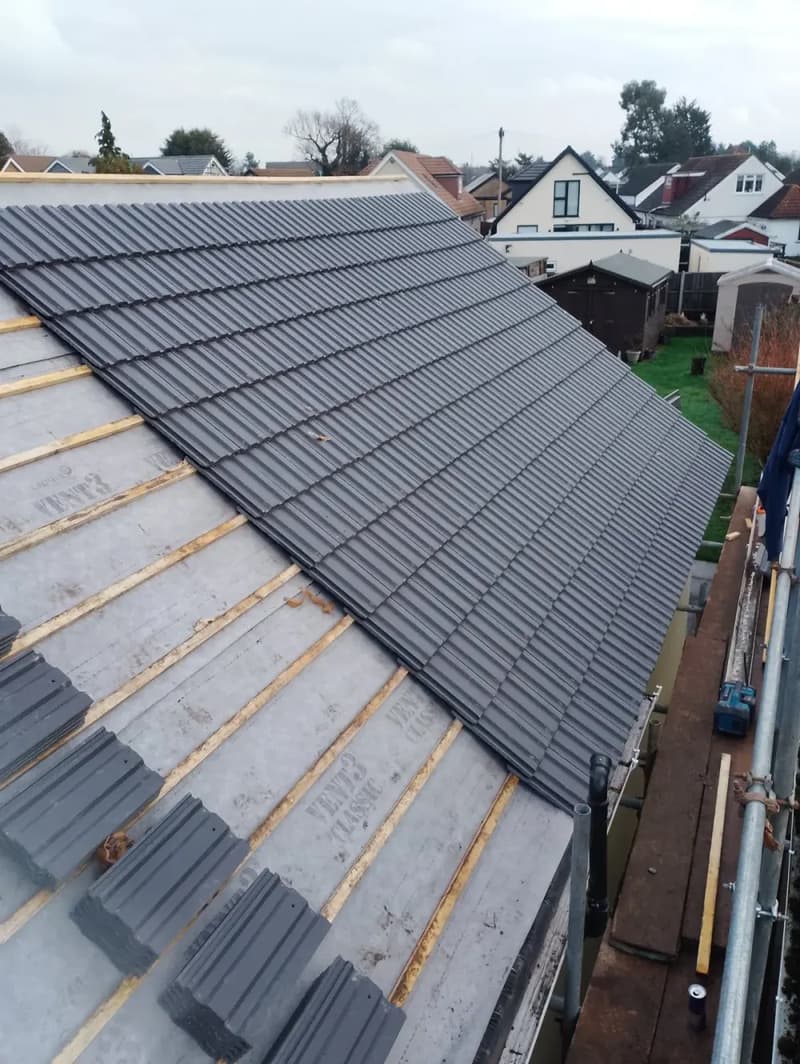
What roof underlay actually does
Tiles and slates shed most of the rain, but not all of it. Gusts push water and fine snow up through the laps, and a cracked tile lets a little in before anyone notices. The underlay is the second line of defence: it catches that water and carries it down to the gutter. It also cuts the wind pressure acting on the underside of the tiles, which helps them stay put in a storm.
On many houses built before the middle of the last century there is no underlay at all, only the tiles and sometimes torching, a lime mortar pointed along the underside of each course. Those roofs can still work, but they rely entirely on the covering being in good order.
Traditional bitumen felt
For decades the standard underlay was black bitumen felt, often reinforced with hessian or fibre, draped between rafters and held down by the battens. It is waterproof but not vapour-permeable, so warm, moist air rising from the rooms below condenses on its cold underside. That is why lofts under felt need ventilation gaps at the eaves and sometimes at the ridge.
With age, felt becomes brittle. The strip that runs into the gutter is exposed to sunlight and is often the first part to rot away, leaving the fascia wet and timber at the eaves exposed. Elsewhere it tears where it has been pushed against battens, or sags so far between rafters that it holds water.
How a breathable membrane differs
Modern membranes are made from layers of spun or microporous plastic. Liquid water cannot pass through them, but water vapour can, so moisture from the house can find its way out instead of collecting on the underside. They are much lighter than felt, come in wide rolls and are laid with taped or overlapped joints.
Breathable does not mean a loft needs no air at all. Some membranes are designed to be used with eaves and ridge ventilation, others with less; the manufacturer's guidance and the way the loft is insulated decide which. Our roof ventilation page explains the vents that may be needed alongside a new membrane.
Signs the underlay has failed
Look in the loft on a dry day with a torch, then again after heavy rain. The common warning signs are:
- Felt that crumbles or flakes when touched, or has holes where light shows through.
- Black streaks or drip marks on the loft floor or insulation directly below the felt.
- A rotted felt edge at the eaves, with wet fascia boards or staining below the gutter.
- Heavy condensation on the underside of the felt in cold weather, with mould on rafters.
- No underlay at all and loose or missing torching on an old roof that has started to let in wind and dust.
When roof felt replacement makes sense
If only the eaves strip has gone, a roofer can lift the bottom courses, fit an eaves carrier or a new strip of membrane dressed into the gutter and relay the tiles. That is a local repair. Where the underlay has failed across a whole slope, the tiles, battens and old felt all have to come off, which is effectively the work of a re-roof, and new battens are fitted at the same time.
That is why most homeowners deal with underlay as part of replacing the covering. If the tiles are also ageing, it is worth comparing coverings first; our roof tile types guide sets out how concrete, clay and slate differ. Spray foam applied to the underside of tiles is not a substitute for underlay and can make future repairs, mortgage surveys and timber inspections harder.
Need it sorted? Book a new roof quote
Underlay is renewed as part of our new roofs work, with new battens and the covering relaid. Request a quote and we will look at the loft and the slopes before giving you a written quotation.
Get a quoteWant a professional to handle it?
Frequently asked questions
Can roof felt be replaced from inside the loft?
Not properly. The underlay sits under the battens and tiles, so it has to be laid from outside with the covering removed. Patching from inside does not reconnect it to the gutter.
Is a breathable membrane better than felt?
For most re-roofs, yes: it is lighter, resists tearing and lets moisture escape, which lowers the risk of condensation. The loft still needs the right ventilation for the membrane used.
My old roof has no felt at all. Is that a problem?
Not in itself if the tiles and torching are sound. It does mean any slipped or cracked tile lets water straight in, and adding underlay requires the roof to be stripped.
Related services
Covering Staines, Surrey and West London.
More guides
- What does a flat roof replacement cost?
- GRP vs rubber (EPDM) vs felt: which flat roof is best?
- Why is my roof leaking? Common causes and fixes
- How long does a new roof take?
- Dry ridge vs mortar ridge: which is better?
- How much does a new roof cost?
- What does guttering and fascia replacement cost?
- What affects the cost of a roof repair?
- Why is my flat roof leaking?
- Felt roof repair
- Slipped and broken roof tiles
- How much do chimney repairs cost?
- How long does a flat roof last?
- Roof valley repair
- Chimney Leaking? Causes and Fixes
- Do You Need Planning Permission for a New Roof?
- Sagging Roof: Causes and What to Do
- Roof tile types: concrete, clay and slate compared
- Condensation in the loft: causes and fixes
- Garage roof replacement cost: what drives the price
- Rubber roof cost: what decides the price of EPDM
- How long does a roof last?
- Water coming through the ceiling: roof, pipe or condensation?
- Storm damage to a roof: what to do next
- Is moss bad for my roof? When roof moss matters
- Asbestos garage roof removal cost: what affects the price
- GRP roof cost: what decides the price of a fibreglass roof
- Chimney removal cost: what changes the price
- Gutter overflowing? Causes and how to fix it
- Roof tile replacement cost: what affects the price
- Slate roof cost: what decides the price
- Lead flashing cost: what decides the price
- Flat roof ponding: why water sits and what to do
- Flat roof blistering: causes and when to repair
- Can you claim roof repairs on insurance?
- Felt roof cost: what affects the price