
The short answer
Flat roof blistering is a raised bubble or dome in the covering, most often seen on felt and bitumen roofs. It forms when air or moisture is trapped between layers, or between the covering and the deck, and expands as the sun heats the roof. A small, intact blister is not leaking; one that has cracked, keeps growing or sits among many others needs repair.
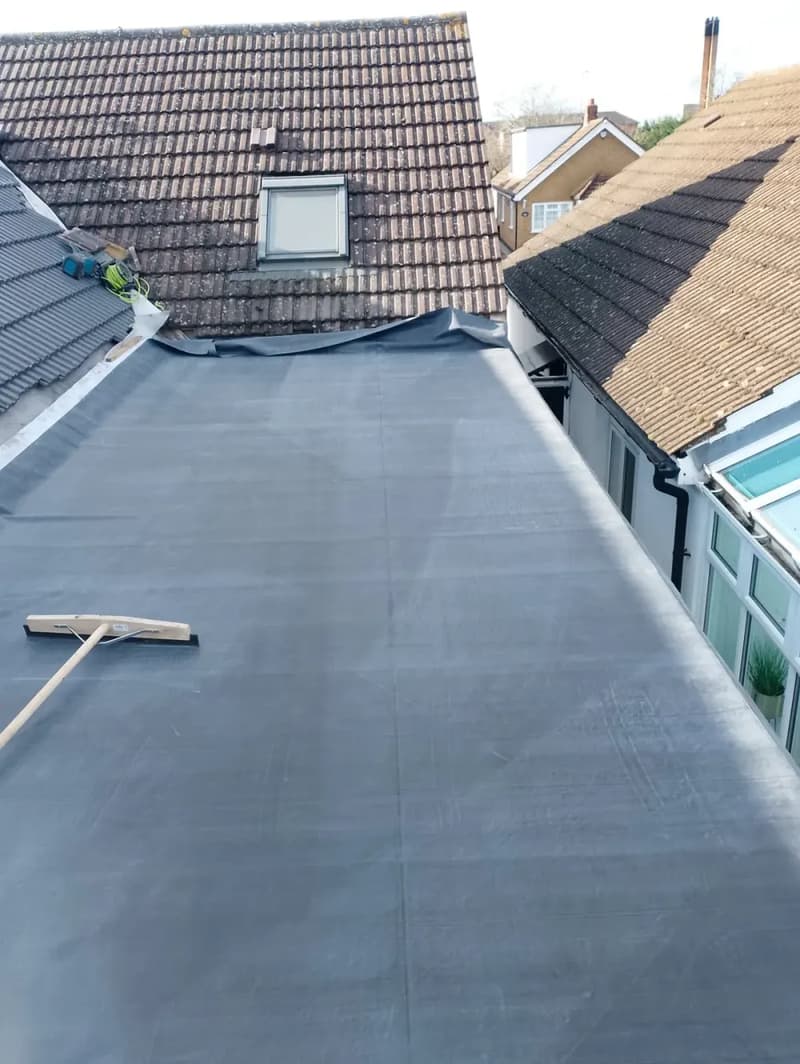
How blisters form
Built-up felt roofs are made of several bonded layers. If a pocket is left where the layers did not fully stick, or if the deck was damp when the felt went down, a small amount of air or water vapour is sealed in. On a warm day the roof surface gets very hot, the trapped air expands and pushes the felt upward. It shrinks back a little when cool, then expands again the next sunny day, and over time the blister grows and the felt above it stretches and thins.
Moisture getting in from a nearby leak, or rising from a damp space below on a roof without a vapour control layer, can feed the same process.
Which roofs blister
Blistering is mainly a felt and bitumen problem, because the material softens with heat and relies on bonding between layers. EPDM rubber can show loose areas or wrinkles if its adhesive fails, and GRP can delaminate in places, but neither tends to produce the classic bubbled surface that ageing felt does.
When a blister needs attention
Use these as a guide:
- A single small blister with an unbroken surface can be monitored over a summer.
- A blister that has cracked or split across the top lets water in and needs repairing.
- Blisters that are getting larger each year suggest moisture is feeding them.
- Many blisters across the roof usually mean the layers are failing generally.
- Soft or spongy deck underfoot around a blister points to wet boards beneath.
- Staining on the ceiling below, particularly after warm weather followed by rain.
How blisters are repaired
A sound, isolated blister is usually best left alone, because cutting into it creates an opening that must be sealed. Where repair is needed, the usual approach is to cut out the blistered area, let the layer and deck dry, check the boards, then bond in new felt over the area with overlaps onto the sound material around it. Our felt roof repair guide explains how felt patches are made and how long they last.
If blistering is widespread, patching each one only chases the problem. Re-covering the roof, with the deck dried or replaced and a vapour control layer where needed, deals with the cause.
Avoid walking on blisters or piercing them with a screwdriver to let the air out; that simply invites water in.
Blistering compared with ponding
Blisters push up from within the covering; ponding is water sitting on top of a roof that does not drain. They can occur on the same roof, since water held in a pond can find a cracked blister, but they are diagnosed and fixed differently. If water stays on your roof after rain, see our flat roof ponding guide.
Preventing blisters on a new roof
Blisters are far less likely when the deck is dry and clean before laying, layers are fully bonded, and a vapour control layer is used on warm roofs over heated rooms. Those points are worth asking about when getting quotes for a replacement felt roof.
Need it sorted? Book flat roof repairs
Cracked blisters and lifted felt are repaired through our flat roof repairs service. Request a quote and say roughly how many blisters you can see.
Get a quoteWant a professional to handle it?
Frequently asked questions
Should I pop a blister on my felt roof?
No. Piercing it lets water into the layers. An intact blister can be monitored; a cracked one needs cutting out and patching properly.
Does blistering mean my flat roof is leaking?
Not necessarily. Blisters with an unbroken top are not letting water in. They become a leak risk when the surface splits.
Why do blisters appear in hot weather?
Trapped air and vapour expand as the roof heats in the sun, pushing the softened felt upwards, then contract slightly as it cools.
Can blisters be prevented?
Laying on a dry deck, bonding layers fully and including a vapour control layer where needed greatly reduce the risk on a new roof.
Related services
Covering Staines, Surrey and West London.
More guides
- What does a flat roof replacement cost?
- GRP vs rubber (EPDM) vs felt: which flat roof is best?
- Why is my roof leaking? Common causes and fixes
- How long does a new roof take?
- Dry ridge vs mortar ridge: which is better?
- How much does a new roof cost?
- What does guttering and fascia replacement cost?
- What affects the cost of a roof repair?
- Why is my flat roof leaking?
- Felt roof repair
- Slipped and broken roof tiles
- How much do chimney repairs cost?
- How long does a flat roof last?
- Roof valley repair
- Chimney Leaking? Causes and Fixes
- Do You Need Planning Permission for a New Roof?
- Sagging Roof: Causes and What to Do
- Roof tile types: concrete, clay and slate compared
- Condensation in the loft: causes and fixes
- Garage roof replacement cost: what drives the price
- Rubber roof cost: what decides the price of EPDM
- How long does a roof last?
- Water coming through the ceiling: roof, pipe or condensation?
- Storm damage to a roof: what to do next
- Breathable roof membrane or traditional felt: roof underlay explained
- Is moss bad for my roof? When roof moss matters
- Asbestos garage roof removal cost: what affects the price
- GRP roof cost: what decides the price of a fibreglass roof
- Chimney removal cost: what changes the price
- Gutter overflowing? Causes and how to fix it
- Roof tile replacement cost: what affects the price
- Slate roof cost: what decides the price
- Lead flashing cost: what decides the price
- Flat roof ponding: why water sits and what to do
- Can you claim roof repairs on insurance?
- Felt roof cost: what affects the price