
The short answer
A concrete tile roof is the heavy, practical choice found on most post-war houses; clay tiles, including Rosemary-style plain tiles, give a traditional finish and keep their colour; natural slate, such as Welsh slate, is thin, light for its strength and suits steeper period roofs. The right covering depends on the roof pitch, what the timbers can carry, the look of the street and budget.
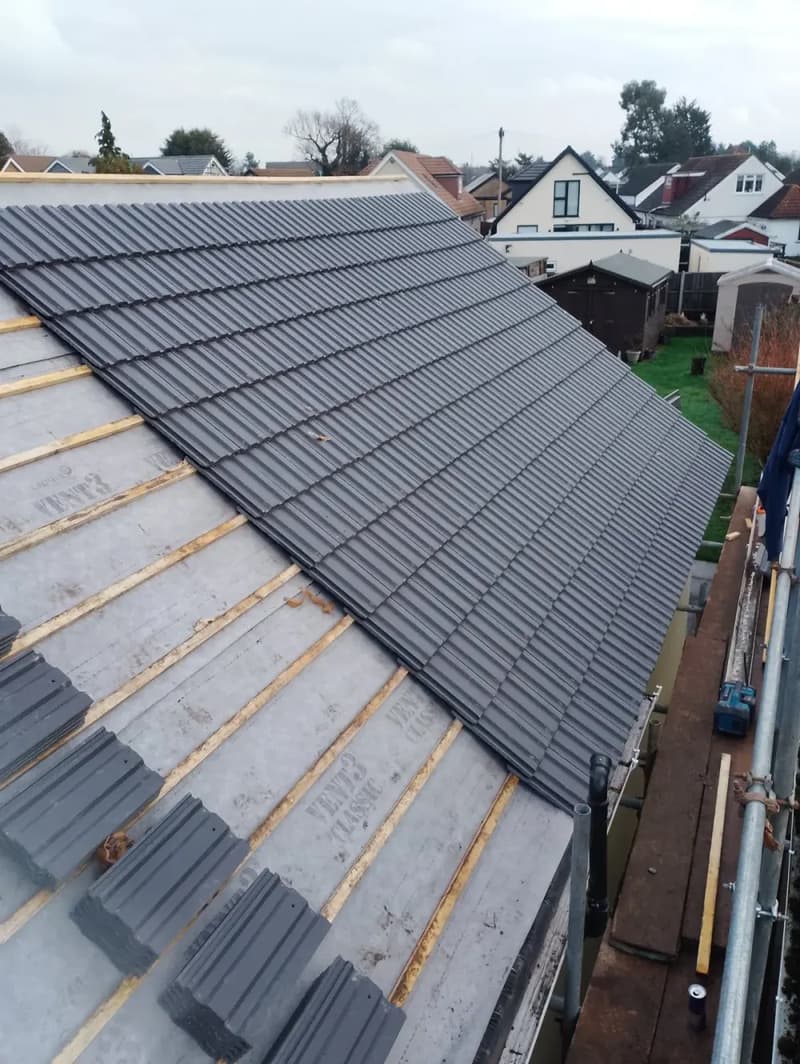
Concrete tiles
Concrete tiles are made from sand and cement pressed into moulds and coloured on the surface. Most are interlocking: each tile has grooves along its sides that hook into the next one, so a single course covers a lot of roof and laying is quick. Plain concrete tiles, the small double-lapped kind, also exist and mimic clay.
Interlocking concrete tiles are heavy per tile but relatively few are needed. They work on lower pitches than plain tiles or slate, which is one reason they were used so widely on 1950s to 1980s estates and on re-roofs of older houses. Their surface colour fades and they gather moss over time, but the tile body usually stays sound. Where a roof of this kind fails, it is more often the underlay, battens or ridge mortar than the tiles themselves.
Clay tiles and Rosemary tiles
Clay tiles are fired in a kiln, so their colour runs right through the tile and mellows rather than fading. Plain clay tiles are small, slightly curved and laid double-lapped, which means a lot of tiles per square metre and more labour. They suit steeper roofs and are typical of Edwardian, Arts and Crafts and inter-war houses. Rosemary is a long-established brand name for clay plain tiles, and the name is now often used loosely for any small red-brown plain tile. Handmade and machine-made versions differ in texture and price.
Clay is also made in interlocking and pantile shapes for lower pitches. Because clay tiles weather well, sound originals are often reused on a re-roof, with reclaimed tiles making up the numbers.
Natural slate and Welsh slate
Natural slate is split from quarried rock into thin, flat pieces. Welsh slate is the classic covering of Victorian terraces across London and the South East; slate from other countries is common on newer roofs. A slate roof is lighter than a concrete tile roof of the same area, but slate needs a reasonable pitch and careful fixing because each piece relies on its overlap to keep rain out.
A natural slate roof gives a crisp, thin profile. Its lifespan depends heavily on the slate quality and on the fixings: many old slate roofs fail because the nails corrode long before the slate wears out. Man-made fibre-cement slates offer a similar look at a lower weight and with uniform sizing.
How the three compare
Without quoting prices, these are the practical differences a roofer weighs up:
- Weight: interlocking concrete is the heaviest per square metre on most roofs; plain clay is also heavy because of the double lap; natural slate is lighter for the area covered.
- Lifespan factors: all three can last a long time. Fixings, battens, underlay, exposure and maintenance usually decide when a roof needs replacing, rather than the tile alone.
- Look: concrete is uniform and chunky, clay is warm and textured, slate is thin and dark with sharp lines.
- Pitch: interlocking concrete and clay interlocking tiles suit lower pitches; plain tiles and slate need steeper slopes, and every product has a minimum pitch set by its maker.
- Cost drivers: the material itself, the number of pieces per square metre, labour time per square metre, the detailing at hips and valleys, and whether old tiles or slates can be reused.
Changing from one covering to another
Switching covering is possible but needs thought. Moving from slate to concrete adds weight, so the rafters must be checked. Moving from concrete to slate reduces weight but needs the right pitch and a new batten gauge. Changing the material on a listed building or in a conservation area, and sometimes on the front of any house, may need consent; our planning permission and building regulations guide explains when.
For the replacement itself, see our slate roofing page for slate, or new roofs for tile.
Need it sorted? Book a re-roof quote
Tell us what is on your roof now and what you are thinking of. Our new roofs team will look at the pitch and timbers and explain the options. Request a quote.
Get a quoteWant a professional to handle it?
Frequently asked questions
Can I swap concrete tiles for slate?
Usually, if the roof pitch is steep enough for the chosen slate. Slate is lighter than concrete, so the timbers are rarely a problem, but new battens at a different spacing are needed and planning rules should be checked first.
Are Rosemary tiles clay or concrete?
Rosemary is a brand of clay plain tile, and the name is often used for small clay plain tiles in general. Concrete plain tiles that look similar are also made, so it is worth checking which your roof has.
Which tile is best for a low-pitched roof?
Interlocking tiles, in concrete or clay, are designed for lower pitches than plain tiles or slate. The maker's minimum pitch for the specific product decides what can be used.
Is Welsh slate the same as natural slate?
Welsh slate is natural slate quarried in Wales. Natural slate also comes from other countries, and quality varies between sources.
Related services
Covering Staines, Surrey and West London.
More guides
- What does a flat roof replacement cost?
- GRP vs rubber (EPDM) vs felt: which flat roof is best?
- Why is my roof leaking? Common causes and fixes
- How long does a new roof take?
- Dry ridge vs mortar ridge: which is better?
- How much does a new roof cost?
- What does guttering and fascia replacement cost?
- What affects the cost of a roof repair?
- Why is my flat roof leaking?
- Felt roof repair
- Slipped and broken roof tiles
- How much do chimney repairs cost?
- How long does a flat roof last?
- Roof valley repair
- Chimney Leaking? Causes and Fixes
- Do You Need Planning Permission for a New Roof?
- Sagging Roof: Causes and What to Do
- Condensation in the loft: causes and fixes
- Garage roof replacement cost: what drives the price
- Rubber roof cost: what decides the price of EPDM
- How long does a roof last?
- Water coming through the ceiling: roof, pipe or condensation?
- Storm damage to a roof: what to do next
- Breathable roof membrane or traditional felt: roof underlay explained
- Is moss bad for my roof? When roof moss matters
- Asbestos garage roof removal cost: what affects the price
- GRP roof cost: what decides the price of a fibreglass roof
- Chimney removal cost: what changes the price
- Gutter overflowing? Causes and how to fix it
- Roof tile replacement cost: what affects the price
- Slate roof cost: what decides the price
- Lead flashing cost: what decides the price
- Flat roof ponding: why water sits and what to do
- Flat roof blistering: causes and when to repair
- Can you claim roof repairs on insurance?
- Felt roof cost: what affects the price