
The short answer
Flat roof ponding is water that stays on a flat roof long after rain has stopped, commonly taken as still sitting there around 48 hours later. It happens when the roof lacks enough fall, the deck has sagged between joists, or outlets and gutters are blocked. A few shallow puddles that dry quickly are normal; deep or growing ponds speed up wear and point to a problem underneath.
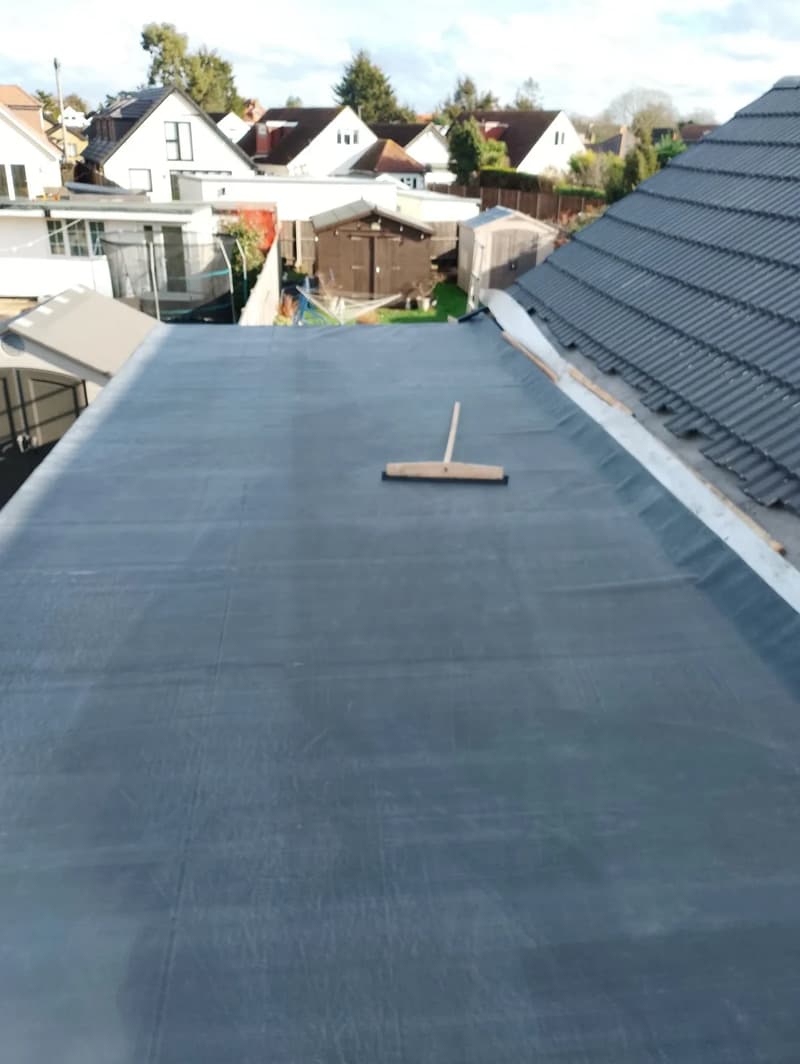
Flat roofs are not truly flat
A flat roof should be built with a slight fall, a gentle slope towards a gutter or outlet, so that rainwater runs off. That fall is achieved either by angling the joists or by fixing tapered timber firrings on top of them before the deck goes on. When the fall is too slight, missing altogether, or works against the outlet, water collects in the lowest part instead of draining.
Common causes of ponding
Ponds usually trace back to one of these:
- Insufficient fall built in when the roof was first constructed or last replaced.
- Deck boards that have softened and sagged between joists, often after a slow leak has soaked them.
- Joists that have deflected under load or been undersized for the span.
- Blocked outlets, gutters or hopper heads, so water backs up across the roof.
- A raised edge trim or upstand that traps water with nowhere to go.
- Insulation boards that have compressed or been laid unevenly on a warm roof.
Why standing water matters
Most flat roof coverings can tolerate brief wetting, but water sitting for days keeps the same area under constant load and exposure. On felt it encourages the surface to break down and the laps to lift; dirt left behind as ponds evaporate builds up and holds more moisture. The extra weight in a deep pond can make a sagging deck worse, which deepens the pond, and so on. If the covering is already damaged, standing water finds the weakness quickly.
It is also a sign worth checking against the inside: a stain on the ceiling below a pond often means the water is already getting through. Our flat roof leaking guide explains how leaks are traced.
How ponding is fixed
If the cause is a blocked outlet, clearing it may be all that is needed. Where the roof simply lacks fall, a lasting fix means lifting the covering, adding firrings or tapered insulation to create a slope, and relaying the deck and covering. A sagging deck caused by rotten boards needs the soft boards replaced, and any weak joists strengthened, before a new covering goes on.
Localised low spots can sometimes be built up under the covering during a repair, but on most domestic roofs correcting falls properly happens as part of re-covering the roof. This is the moment to also check outlets are large enough and placed at the low point.
Ponding is not blistering
Ponding is about water sitting on top of the roof. Blistering is about air or moisture trapped within or under the covering, which pushes it up into domes. The two can appear together on an old felt roof, but they have different causes and fixes; our flat roof blistering guide covers the latter.
What to check yourself
After heavy rain, note where water collects and how long it stays; a photo each day for a couple of days is useful evidence. Check outlets and gutters you can safely see for leaves and silt, and look at the ceiling below the low spot for staining.
Need it sorted? Book flat roof repairs
Blocked outlets, soft boards and lifted laps are handled by our flat roof repairs service. Request a quote with a photo of where the water sits after rain.
Get a quoteWant a professional to handle it?
Frequently asked questions
How much standing water on a flat roof is normal?
Small, shallow puddles that disappear within a day or two of rain are common. Water still present around two days later, or ponds getting larger, need looking at.
Can ponding be fixed without a new roof?
If an outlet is blocked, yes. Correcting a lack of fall or a sagging deck usually means lifting the covering and rebuilding the slope underneath.
Will a new covering stop ponding on its own?
Not unless the falls are corrected underneath. A new covering laid on the same flat deck will pond in the same place.
Is ponding covered by a flat roof guarantee?
That depends on the terms given by whoever laid the roof. Check any paperwork you have and ask them directly.
Related services
Covering Staines, Surrey and West London.
More guides
- What does a flat roof replacement cost?
- GRP vs rubber (EPDM) vs felt: which flat roof is best?
- Why is my roof leaking? Common causes and fixes
- How long does a new roof take?
- Dry ridge vs mortar ridge: which is better?
- How much does a new roof cost?
- What does guttering and fascia replacement cost?
- What affects the cost of a roof repair?
- Why is my flat roof leaking?
- Felt roof repair
- Slipped and broken roof tiles
- How much do chimney repairs cost?
- How long does a flat roof last?
- Roof valley repair
- Chimney Leaking? Causes and Fixes
- Do You Need Planning Permission for a New Roof?
- Sagging Roof: Causes and What to Do
- Roof tile types: concrete, clay and slate compared
- Condensation in the loft: causes and fixes
- Garage roof replacement cost: what drives the price
- Rubber roof cost: what decides the price of EPDM
- How long does a roof last?
- Water coming through the ceiling: roof, pipe or condensation?
- Storm damage to a roof: what to do next
- Breathable roof membrane or traditional felt: roof underlay explained
- Is moss bad for my roof? When roof moss matters
- Asbestos garage roof removal cost: what affects the price
- GRP roof cost: what decides the price of a fibreglass roof
- Chimney removal cost: what changes the price
- Gutter overflowing? Causes and how to fix it
- Roof tile replacement cost: what affects the price
- Slate roof cost: what decides the price
- Lead flashing cost: what decides the price
- Flat roof blistering: causes and when to repair
- Can you claim roof repairs on insurance?
- Felt roof cost: what affects the price